Search This Blog

Showing posts with label A321. Show all posts

Thursday, February 5, 2015

VietJet Air wants to grow aggressively, gets money to do it, needs even more money

A VJ A320 in typical company livery. There are several planes
acting as flying billboards, with large advertiser logos.
VietJet Air (IATA code: VJ) is not the first privately-owned airline in Vietnam, but has been the most successful up until now, and has aspirations of continuing its success in a big way.

This is even more notable in that it's primary competitor is state-run Vietnam Airlines (VNA), with a deep war chest of funds to rely on. Most other private competitors have folded shortly after commencing service.

What sets VJ apart is its low cost carrier (LLC) concept, versus VNA's traditional full-service. VJ charges a very low base fare for the plane ticket itself (sometimes as low as US$0), then has fees for almost everything else; ticketing, preselecting seats, purchasing food and drinks on board, even just the mere act of paying in any form incurs a fee.


Leaked photo alledgedly from a bikini
photoshoot onboard a VJ aircraft.
Image source: Tuoi Tre News
Its exuberance has also drawn the ire of the socially conservative Vietnamese government, their most famous incident being an unauthorized in-flight bikini show in 2012 that lead to a nearly US$1,000 in fines. More recently in late 2014, photos were leaked from a purported racy photoshoot that VJ has since disclaimed as unauthorized and not part of an official company promotion.

The company currently has 20 Airbus A320 aircraft operating 150 flights a day to every major city in Vietnam, and several smaller communities, but that's still not enough.

Last year, VJ committed to acquiring up to another 93 A320-family aircraft from Airbus for up to US$9 billion at list prices... even though airlines usually don't pay full price, that's a lot of planes for a young startup company. The order includes 14 current A320s, 43 more-efficient A320neos, and 7 of the larger A321s (the same aircraft VNA uses as its workhorse), with the remaining as options for additional aircraft.

To assist VJ's fleet expansion plans, TPBank of Hanoi has extended a US$400 million line of credit for their initial set of aircraft. This is on top of a US$21 million credit for the down payment of the Airbus order.

VJ is also mulling a bond sale to raise US$200-300 million. as well as an initial public offering (IPO) aimed to raise another US$500-800 million.

Plans for international long-haul expansion have been tempered to focus on strengthening it's domestic network and growing its regional footprint. VJ has decided to take the strategically safer growth plan and temporarily hold off on acquiring widebody aircraft for long-haul services. 

Delaying the start of long-haul service on widebody jets is probably a smart play, especially in light of Japan's Skymark Airlines (BC) declaring bankruptcy, due mainly, according to experts, to its order of the massive Airbus A380 to start Tokyo-New York service, even though BC was primarily a domestic airline using single-aisle aircraft.

2015 should prove an interesting year for VJ, as well as VNA if VJ continues on its trajectory of growth and revenue.

What has been your experience with VJ... would you recommend them? If you haven't flown VJ, would you give them a change, or would you rather stick to traditional-service VNA?

Tuesday, February 3, 2015

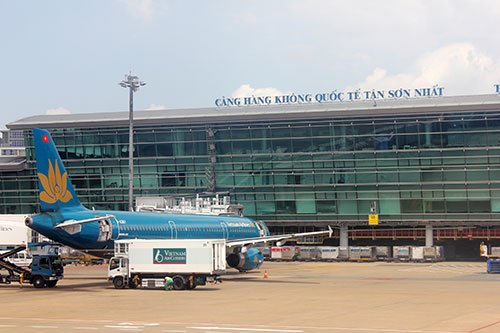
Trip Report: Arrival at Tan Son Nhat Airport (SGN)

Other chapters:
Upon our arrival, our Airbus A321 parks at a remote stand, thus requiring airport buses to get us to the terminal. Along with past experiences, it seems that when Vietnam Airlines (VNA) uses A321s for regional services, those flights are highly likely to be assigned to these remote gates, probably saving the jetbridges for widebodies.

Read more: Vietnam Airlines' Boeing 787: New Lie-Flat Seats in Business, 2 Different Economy Configurations

Image source: Vietnam Investment Review
One (very tiny) upside to the remote stand is that they deplane and board through both the front and back at the same time, so those stuck in the rear of the plane aren't waiting forever to get off.

Those in business class are provided their own shuttle bus, which departs quickly. The economy passengers are directed to 3 other larger buses, each one taking off once full.
Pro Tip: Stand near the left-side doors to be the first to get off at the terminal.
After a 5-7 minute ride to the terminal, we are deposited at the entry doors which lead to a narrow escalator that took us up to the arrivals level. We follow the signs to the arrivals hall, just a short walk away.

The arrivals hall at SGN is divided up into three sections:
  • The main immigration inspection section, where passports are checked before entry.
  • A visa window, for those who pre-arranged to receive a "visa on arrival."
  • A transfer desk, for those who are making onward international connections.
Today was a little busy, with at least 3/4 of the immigration booths manned, and each having lines of 15-20 passengers each. The visa window had about 20 people waiting in line, with another 30 waiting for their applications to be processed.

Our line has a passenger that they examined more closely than normal, so it takes us about 30 minutes to finally get through (should have been about 15 minutes). We head down to claim our baggage, which is already sitting off the belt, as our flight's bags have completed offloading. We load our bags onto free carts provided by the airport, and my wife goes for a restroom break.

While I'm waiting, I scan the customs inspection lines that we have to go through before exiting. A customs "officer" tries to wave me over, but I give the "not ready" hand signal and continue waiting.
Pro tip: Never go towards a customs line that you've been directed to, since frankly you don't have to follow their direction. The sad reality is that forced bribery is alive and well at SGN and other airports, and the agent is essentially fishing, trying to get me to come over so I can be "carefully inspected" and assessed some sort of trumped up violation, in hopes that I will "pay the fine" on the spot.
What one should do is to choose a line that looks like someone is already "being spoken to" since they already busy with that person and will let you pass.
When my wife returns, I guide our carts to a line far away from that agent. We successfully have our baggage x-rayed with no challenge, and we were quickly on our way out to the curb.

As we pass by, I overhear a poor American fellow in his mid-50s who was trying to reason with the customs agent, who in turn threatened to detain his baggage for 3-4 days. Shameful... I wanted to help him too, but I also didn't want to stick around and be inspected myself (though I probably would have if I was by myself).

We make our way through the throngs of people waiting for their loved ones, make a left turn and head towards the taxi "stand" near the end of the terminal building, past the Popeye's Fried Chicken stand (great place for a quick and cheap snack or drink).

The stand is really more of a collection area where taxis pick up customers, and no real defined queue, even with the permanent corral set up.
Pro tip: Walk past the taxi corral and the crowds, farther along the curb. Flag down the taxi of your choice when it approaches. The driver doesn't really care who they pick up. This is how the system at SGN works. 
If you're uncomfortable with this, you'll probably be waiting a while, but you can get a dispatcher to help you. Each taxi company has its own dispatcher in uniform in the taxi area.
I prefer Vinasun... it has the most number of taxis in the company, are the most reliable, and always use the meter. MaiLinh is a decent Plan B. I pretty much avoid all other taxi companies.
Taxi pickup area at SGN.
We quickly get into a Vinasun taxi van and we're on our way into the city.

Stay tuned for the rest of my trip report, before our Shanghai-Saigon flight and on our way home. Thanks for reading!
- VNAFlyer


Trip Report: Flying PVG-SGN on Vietnam Airlines on an A321

Other chapters:
Author's note: Yes, it's weird that I have a VNA segment in this itinerary. It was an AA fare where the rules allowed for a connection onto VNA from AA's PVG flights.

Another VNA A321, heading to Hanoi (HAN)
Thankfully, the scrum that seems to always occur at Chinese airports didn't occur here... it might have even been quite orderly! They call boarding for business class first, and then economy in general, with everyone observing the queue. Armed with hand-notated BPs saying that we were in Row 14 exit row seats (and out of Row 33), I'm feeling mighty content as we board Flight VN523...

... until we actually get to our seats. For some reason, Vietnam Airlines (VNA) designates the row in front of  the doors on an A321 as exit row seats as well. No extra leg room, no recline, and not even a window! Much to our chagrin, all the seats in Row 15 (the actual exit row, as we all know what "exit row" actually means) are actually assigned. How they got assigned, I have no idea, because they were clearly non-status passengers (based on a quick, coincidental scan of their BPs, as well as their fairly naive questions about such things as tray tables and such). The fact is, what the manager and agent said at check-in was completely wrong. Those seats were definitely preassigned, even on a flight that was not full.

A Juneyao A320 parked next to us.
In any case, what also seems to happen is that Rows 10-14 (no Row 13) also are the last to be assigned. When boarding was complete, no one was sitting in Rows 10-14 except for us. I quickly flag down the nearest flight attendant (FA) to ask if we could move, and she happily said that we could choose any seat we wish. Interestingly, this same FA was earlier policing this section, asking passengers who sat down in this section for their BPs and moving them along to their original seats.


Thankfully, we moved out of Row 14 to Row 12. A few other passengers apparently take our move as their cue to move as well, but it isn't a total exodus, more of a spreading out, with a maximum 2 passengers for every 3-seat section.

Interlude: The lesson with VNA is to be persistent, and don't accept their answer, even from a manager or supervisor. It's like a game of chicken or a staring contest... who will give up first? I've had other experiences with VNA that leads me to the same conclusion. Just don't give up, because the culture of the ground staff is to refuse first, hoping passengers will accept what's given to them.

The door closes and we push back 10 minutes past our time of departure. Safety announcements are conducted in Vietnamese, Mandarin, and English. It takes about 15-20 minutes for us to taxi to a runway on the other side of the terminal, giving us a nickel tour of PVG.

A China Southern 737-800 heading towards PVG's control tower.

An American 777-200 followed by a China Eastern 737-800.
Love it or hate it, that new tail makes the AA bird easy to spot.
No further delay as we smoothly take off towards the northwest, make a left turn, and loop around Shanghai then south to Vietnam. The smog is unbelievable... not as bad as Beijing, but still sickeningly thick, much worse than LA has ever gotten.


When you need a paint
that can withstand
Armageddon....
As soon as we hit 10,000 feet and hear the ding, the FAs all jump into action, and the curtain to the first class cabin is ceremoniously closed. The FAs walk down the aisle was a basket of packaged refreshing wipes for the economy passengers, quickly followed by drink service. 

There is a small lull before meal service, so I check out the VNA inflight magazine, Heritage, which has articles in both Vietnamese and English.

The crew comes through with an offering of chicken or fish. As a personal rule, I always avoid airplane fish in coach, so chicken it is!

The chicken is similar to a teriyaki chicken, with linguini, and steamed green beans... definitely better than expected. 

I wasn't going to buy
Kohler, but the attractive
model with a rose
changed my mind.
The side salad, on the other hand, is quite frankly gross. The shrimp look like they were frozen for too long, then dipped in hot water before being tossed onto the salad, and the veggies look wilted. I don't even bother opening the salad.

Dessert was cut fruit ("fresh" was questionable), and the crew also came through with hot tea and coffee. Overall, it's a serviceable lunch on a 4-hour flight, but I'm glad we had brought snacks.

The rest of the flight is pretty uneventful.  Entertainment is in the form of Vietnamese variety shows on small overhead screens, with headset provided in the seatback pocket. Blankets and pillows were also provided, nice touch for coach.

The FAs did their jobs quite well, and was generally personable overall. Interestingly, the FA who primarily served our section was a native of Japan who spoke only Japanese and English... no Vietnamese.

Only a couple of people try to go up front to use the lav, and they were turned away. There are 3 lavs in the far rear of the plane, so the parade of passengers was constant. The cabin temperature was a touch on the warm side, but tolerable. 
Descending into Saigon.

We land at SGN right on time, and taxi to a remote stand for arrival.

Next chapter: Arrival at Tan Son Nhat Airport (SGN)


Monday, February 2, 2015

Trip Report: Getting to Shanghai Pudong Airport (PVG) and checking in with VNA

Other chapters:
  • Intro: Ticketing and Getting Ready
  • Checking in at Seattle-Tacoma International Airport (SEA)
  • SEA-LAX on Alaska Airlines
  • Quick stop in Los Angeles
  • Checking in at Los Angeles International Airport (LAX)
  • LAX-PVG on American Airlines
  • Another quick stop in Shanghai
  • Getting to Shanghai Pudong Airport (PVG) and checking in with VNA (current entry)
  • Flying PVG-SGN on Vietnam Airlines on an A321
  • Arrival at Tan Son Nhat Airport (SGN)
Author's note: Yes, it's weird that I have a VNA segment in this itinerary. It was an AA fare where the rules allowed for a connection onto VNA from AA's PVG flights.
The check-in hall at PVG.
We take good old reliable UberX from our hotel to Shanghai Pudong Airport (PVG). Our driver, with a clean and fully-optioned Nissan sedan, spoke decent English, well enough to crack a couple of jokes, then quietly and efficiently got us to the airport, even offering us bottled water along the way. 

UberX is my preferred way to travel to/from PVG, definitely over taxis, but with 2 people and luggage, it was nearly the same price and more convenient than the maglev train, which requires walking about 250 meters to transfer to the Shanghai Metro subway system.

43USD and 45 minutes later, we find ourselves in the terminal. 

First order of business is to retrieve the bags we had deposited at the left luggage counter. We pay our remaining balance of 25CNY (~4USD; 200CNY [32USD] paid from before) and grab our bags and boxes from the back room, untouched from where we left them the previous day. I'm quite pleased with this service and would totally use it again... it made our short visit to Shanghai so much easier.

We load our luggage carts (free at PVG) and head upstairs to the central check-in area. 

We find the Vietnam Airlines (VNA) counter, which has plenty of staffing but no one in line, even with 2 departures to Saigon (SGN) and Hanoi (HAN) within 1.5 hours. The counters are actually staffed by China Eastern (MU) employees, overseen by VNA managers... the boarding passes are even printed on MU paper. 

While the employees obviously know how to work the computer system, they don't seem to be authorized to do anything beyond basic functions. Our agent speaks English well enough, and to her credit we are checked in very quickly, in under 5 minutes. When the boarding passes (BPs) are printed showing seats in Row 33 on the A321, we politely asked to move forward. On the map below, you can see why:
Click for: VNA's Airbus A321: The Most Accurate Seat Map Available
This is where the fun really started. The agent says that there aren't any other pairs of seats available. I ask about seats by the emergency exit, and she says that it was VNA's policy of not assigning exit row seats on flights that are not full, so the the system blocked her from assigning those seats.


At this point I know I wasn't going to get anywhere, so I ask to speak with the VNA manager. He is very friendly and tries to help (or so I think), but he repeats the policy of not being able to assign the exit row seats, and that there are no other seats available for us.

After a few minutes of going back and forth, we give up and proceed towards security.

We first go through exit immigration, which is first come-first served. It only takes about 5 minutes since crowds were light, but I can see how it may get backed up during busy times.

Nice architecture at PVG.
Next is security screening, and I notice that in the middle of the area, there is a designated priority security line for VIPs, elites, and premium passengers. Regular lines are about 10 people deep. Yes, I know I'm bad, but I decide to press my luck and hold out our AA Platinum cards with our MU boarding passes for a VNA flight in economy class. By all rights, we shouldn't have been allowed to use the line (no relevant status, no premium cabin, different alliance), and I figure the worst that would have happened would be getting shooed away into another line.


I had guessed correctly that the line attendants either weren't knowledgeable or didn't care, and we are allowed in with no problems whatsoever. I would label this a YMMV (your mileage may vary) situation. We scan our BPs (which, my guess, only checks to see if we have a valid BP or not), had our bags X-rayed (shoe removal not required), and we are through to the gate area in less than a minute.

Passengers milling around  Gate D82
before departure.
We take a couple of people-movers to get to our gate, D82 for the day. The gate area is full of waiting passengers... I guess they showed up 3-4 hours before departure. No signs of gate agents yet, so we find a place to sit and eat some of the snacks we brought along in preparation for being in economy class for 4 hours.

At about 1h15m before boarding, the gate agents show up to start processing the flight. Being the persistent type, I approach another agent about seating. This time, nothing about the policy about not assigning exit row seats, but rather that the seats are already assigned.

Boarding is about to start.
I thank her and step away... and no, I'm totally not satisfied with this answer. When she walks off, I speak to another agent, and her reply is that the seats are open, but they can't assign them at the gate!

If one thing's clear to me, it's that VNA just doesn't want to assign these seats, instruct the agents to not assign the seats, but leave the agents to rely on their own creativity on why the seats can't be assigned.

Finally, I spot another VNA manager who shows up, and I start chatting it up with him. I ask him about the seats, if there was any possibility of getting an exit row seats, and he asks for our BPs and walks away (score!). 

He comes back with the same BPs, but he had scratched off our original seats and handwrote 14A/14B. I inquire about if this was ok, and he assures me that he blocked out those seats for us, so it will be fine.

The happiness of succeeding through persistence is short-lived when we finally get on board...

Friday, January 30, 2015

VNA's Airbus A321: The Most Accurate Seat Map Available

Image source: Kentaro Iemoto/Wikipedia
The Airbus A321-200 (A321) is Vietnam Airlines' (VNA's) workhorse, with 55 currently in service (out of 89 active aircraft in the fleet). I'm pretty much betting that this is the most accurate, and informative, seating map available for VNA's A321. Yes, even better than VNA's own seatmap.

VNA uses their A321s primarily on domestic and regional flights, flying as far as from Saigon (SGN) to Japan. If you're going to be cooped up in a narrowbody upwards of 6 hours, you probably should know where to sit.

The cabin features 2 classes of service: 16 seats in business class (C), and 162 or 168 seats in economy (Y). Most, if not all, of the A321s, including the newest ones, will be the 16C/168Y seat version.

It's important to note that while VNA is taking delivery of several new aircraft a year, there are some A321s that are about 10 years old, and VNA isn't exactly known for keeping their interiors in pristine condition. Just keep your expectations low.

Without further ado... my carefully crafted seat map, based on my own experiences and observations, complete with annotations on specific seats. Enjoy!

(click to enlarge)

Seat/RowComments
Row 1Restricted leg room, with no cutouts.
Row 4A curtain, instead of a hard wall, separates the business cabin from economy; noise from the economy section may be bothersome.
Rows
10-14
Seats tend to be held back from assignment, even at the airport.
Rows 10-12 are reserved for elites and full-fare passengers.
Row 10Extra legroom; underseat storage even though it's a bulkhead row, thanks to curtain divider.
Row 11Less legroom than other rows.
Row 13There is no Row 13.
Row 14No recline due to emergency exit row behind; missing window; no additional leg room, even though this row is designated as an emergency exit row.
Row 15Emergency exit row; extra leg room.
Seat 15EWhile E seats are usually middle seats, this seat has a crew jump seat in the aisle position, so no one will sit there except during takeoff and landing.
Seat 16DRestricted leg room and no underseat storage, due to crew jump seat in front.
Seats 20A/GMissing window.
Seats 21A/GMissing window.
Row 27No recline due to emergency exit row behind; no additional leg room, even though this row is designated as an emergency exit row.
Row 28Emergency exit row; extra leg room. However, missing window.
Seat 28EWhile E seats are usually middle seats, this seat has a crew jump seat in the aisle position, so no one will sit there except during takeoff and landing.
Seat 29DRestricted leg room and no underseat storage, due to crew jump seat in front.
Seats 38A/B/CNo recline due to lavatory behind; noise, odor, and foot traffic from lavatories may be bothersome; missing window.
Seat 38DSeatback will be constantly bumped by passengers to/from the lavatory; Noise, odor, and foot traffic from lavatories may be bothersome; missing window.
Seats 39E/GNo D seat in this row, so 39E is an aisle seat. No recline due to lavatory behind; noise, odor, and foot traffic from lavatories may be bothersome; missing window.