Search This Blog

Showing posts with label tips. Show all posts

Monday, March 23, 2015

Maximize the Layovers on Your Itinerary

It's always worth checking out if you can stay in your connection city on a stopover for a few days, especially if it's a city you enjoy or have never been to before. Even if a stopover isn't allowed, sometime's a longer connection time ("layover") is permitted.

Use layovers to visit places like Hong Kong, Los Angeles, and Tokyo.
Being based in the US, I primarily fly American Airlines (AA), especially to get to an Asia gateway airport on my way to Vietnam.

I've found that on most AA international fares, or fares that include an international segment, so long as you are scheduled to be in your connecting city for less than 24 hours, it's not considered a stopover and therefore doesn't increase the price of your ticket by breaking your ticket up into two separate tickets (if stopovers aren't allowed). This "trick" works on many other airlines as well.

Typically on a purely domestic itinerary, AA generally requires you to take a connecting flight within 4 hours of your arrival at the connection city.

What I've found to be great this use of this layover rule is that it's scalable.. that is to say, the layover rule applies to all your connection points made en route, including any connections in the US. You can spend up to 23 hours, 59 minutes after your schedule arrival in each city, and it may cost exactly the same base fare (there are some variances in taxes and fees).

To illustrate: Let's say you are starting in Dallas (DFW) and in Tokyo-Narita (NRT) on your way to Saigon. A typical sample itinerary may look something like this:
Click to enlarge. Image source: ITASoftware
A standard roundtrip, same-day connections at each connection city, nothing out of the ordinary, prices out at US$873.

Now, what if you wanted to visit, say, Los Angeles for whatever reason (you've never been, you want to grab dinner with friends, you miss your family, etc.).  This is what happens when I price the itinerary with an overnight layover at LAX Airport:
Click to enlarge. Image source: ITASoftware
Notice that I'm scheduled to spend about 21 hours overnight in Los Angeles starting in the late afternoon, giving me enough time, e.g., to pickup my rental car, head to the beach for a couple of hours, grab dinner, grab plenty of sleep, go for a run along another beach, and grab breakfast, all before heading back to LAX to hop on my flight to NRT.

All this for the fare price of $890, or a mere $17 increase from the original boring itinerary, which is just the difference in taxes and airport fees.

If you're lucky, AA may even check your luggage (two free for all, by default) all the way to SGN, so you don't have to deal with it on your long layovers.

This is what happens if I decide to spend a few extra hours in Tokyo before heading to Saigon:
Click to enlarge. Image source: ITASoftware
Instead of a 1.5 hour connection in Tokyo, I now have 9 hours to visit, and it only added US$12 to the previous total. Granted, there's a change in airport, but 9 hours is a lot of time to be able to explore the city before heading to Haneda Airport (HND), which is situated much closer to the central city areas.

Finally, if you wanted to go all crazy on both the outbound and return legs, this is what you can do:
Click to enlarge. Image source: ITASoftware
As you can see here, on the way home back to DFW, I added a 23h05m layover in San Diego and a 23h19 layover in Chicago, all for a mere $51 increase from the original boring itinerary! Scalable...

Obviously, this type of trip isn't for everyone. I personally like taking the opportunity to get a taste of the cities I visit, even if just for a little bit. I figure, if I'm going to fly hours to get to some city, why not leave the airport for a little bit?

There are a few caveats to be aware of:
  • Your fare type (shown as "Q" in the examples above) must be available on all your flight segments.
  • Individual fare rules dictate layover maximum, number of connections, etc.
  • Remember to keep it at 23 hours, 59 minutes or under. If you hit 24 hours, your connection becomes a stopover, which may trigger a stopover fee or break the fare into two separate (and usually more expensive) fares.
  • You'll actually have to price and ticket this itinerary, either by manipulating AA.com or another travel site, using the "multi-city search" feature, or by having an AA agent (phone or airport) ticket what you want. Having an AA agent involved incurs a fee ($35 right now per passenger, but it's going up to $45 soon).
  • This layover trick exist on other airlines as well, though your experience may vary.
If you know the rules, you can fully maximize your trip potential without adding much cost. It's a great way to experience new cities, or revisit favorite ones.

Let me know if you have any success with your long layovers!

Saturday, February 21, 2015

2,700+ AAdvantage Miles for Purchasing Bose Headsets

Earn 2,700+ AAdvantage miles when you purchase from Nordstrom via the AAdvantage Shopping portal by February 26.

I'm a fan of Bose, especially for their noise canceling technology, and their latest headset, the QuietComfort 25, has been receiving rave reviews. As a frequent flyer, these headsets are a necessity, to drown out noise not only in planes but also at airports and other public spaces.

I found the over-the-ear design to be very comfortable and the active noise cancellation was superb, so I was in the market for a pair and have been waiting for the "right moment" to pull the trigger. Others prefer the QC20s, which are in-ear buds with active noise cancellation and a much smaller form factor.

Both the QC20 and QC25 retails for $299, and Bose is known for fixing its prices no matter who the retailer is, so rarely will you find a discount directly off that price. The best you can hope for is some sort of secondary or indirect incentive from the retailer of your choice, such as free add-ons.

I happen to fly American Airlines (AA) a lot, especially to access an Asian gateway airport to connect to Vietnam Airlines, and AAdvantage miles are some of the more valuable airline currency out there.

Therefore, I tend to look for ways to maximize AA miles for purchases. The AAdvantage eShopping portal is one place to check, as it has a large network of online retailers, many of whom offer in-store pickup and/or free shipping.


As it happens, Bose itself is listed in the portal, offering 3 miles per dollar spent, which would be about 900 miles earned from purchasing a set of QC25s.

The best bonus I've seen anywhere for purchasing Bose headsets was 1,500 miles for the previous generation QC15 if purchased through a special link.

Fortunately, several other retailers sell the QC25, and I believe I just found the most lucrative offer currently available... Nordstrom has a special offer of 9 miles/$ spent until February 26 (it's normally 4 miles/$), meaning you can earn over 2,700 miles, since the total purchase price including taxes is used to calculate bonus miles.

Nordstrom also offers free shipping, free returns, and has its own rewards program for using select Nordstrom cards (don't worry, no referral links here). As an example, my QC25 purchase along with couple of other items was enough to earn me a $20 Nordstrom credit I can use on a future purchase.

Of course, if you like Nordstrom anyway, this may be the perfect time for you to start earning miles on things you were already going to buy.

Those who want to take points earning up a notch can use a rewards card that offers 5x points for buying gift cards, including for Nordstrom, from office supply stores. Do a Google search and you'll see what I mean.

Make sure you allow the AAdvantage eShopping website to save cookies to your browser, and don't close the window out. Otherwise, the can't properly track your purchase and credit your bonus miles.

Thursday, February 19, 2015

$25 Ride Discount for Uber, Good for CURRENT Users; Up to $45 for New Users

Uber, for those who haven't heard of it, is a San Francisco-based company specializing in disruptive technology, focusing on transportation modes all over the world, with all transactions (such as calling for a ride and payment) handled through a user's phone app.

The app provides you with real-time data such as the location of your driver, your current location, and final cost of your trip. You can also rate your experience and contact the company for any issues.

Uber is most famous for aggressively usurping the role of taxis by providing a better user experience for a lower cost overall at multiple price points, from the "everyday person" UberX to the luxury private hired car UberBLACK.

I personally use Uber quite a bit when I travel, since I find that it's a much better ride than what you can find with a taxi. Pricewise, it can be cheaper than, as cheap as, or just a little more expensive than a taxi (and the small premium is always worth it over a traditional taxi).

You can find promotional codes for varying discount amounts all over the Internet, but the vast majority is for new accounts only (one such code is "ubermatic" which currently gives you up to $20 off your first ride when you sign up and also gives me Uber credit, for which I would appreciate).

I just found a code that will give up to $25 for your next ride for current account holders, and is stackable with the signup bonus, amounting to potentially $45 in free rides for new users.

Here's how to maximize your credit:

For new users, do this first:
  • Sign up for Uber by clicking here, or by downloading the app.
  • If necessary, enter "ubermatic" as your promotion code (found in the app in the Menu > Promotions) BEFORE you request your first ride.
  • You will have a $20 discount off your first ride stored in your account (or 100,000 VND, for accounts in Vietnam).
For current users (and new users who just signed up):
  • Go to the menu in your app and tap on "Promotions"
  • Enter "roamlikehome" as the code and tap "Apply"
  • A $25 discount off your next ride will be stored in your account
UPDATE: Code "roamlikehome" seems to have expired. Congrats on all those who were able to take advantage!

UPDATE-2 (2/20 @ 12:26pm): The code "roamlikehome" is now fixed and apparently meant to be only for use in Canada for Rogers customers, good only with new Uber accounts, and expires 3/31/2015.

Note that the credits will be applied on subsequent accounts, and you won't get to keep the residual amounts (e.g., if your first ride is only $18, it will be free to you, but you won't get to keep the leftover $2 to use next time).

Disclaimers:
  • "ubermatic" will give both of us ride credit. You aren't required to use the code, but I would appreciate it if you do. I am otherwise not associated with Uber in any other way.
  • "roamlikehome" is a freebie for all of us, and does not give me credit.
  • I can only confirm that "roamlikehome" works in the United States in USD as of the posting of this entry. I cannot confirm how long it will last and if it will work outside the US.
  • Use at your own risk, and your mileage may vary!
Let me know if you were successful by commenting below!

Thursday, February 12, 2015

VNAFlyer's Packing Guide for Carryons (and Packing Them)

Logging lots of miles on a plane each year, on both domestic and international flights, I have developed a routine that I follow when it comes to being equipped. I usually try to survive just with what I have in my carry-ons, but on some trips, especially those back to Vietnam that always turn into resupply missions, I'll have to use my checked baggage allowance. Even then, what I bring with me on board doesn't change much.

The Hardware

Generally I like to travel with a laptop backpack and 21" a spinner rollaboard suitcase, which follows most carriers' restrictions of one carry-on suitcase and one personal item.

Ogio Urban, with laptop section
opened out for security screening.
I choose a backpack over a briefcase or shoulder bag because I frees up both of my hands, and balances out the weight in the bag. The key features I like in a backpack:
  • TSA-checkpoint friendly laptop compartment (it flips out on the X-ray belt so you don't have to take out your laptop)
  • Separate padded tablet compartment
  • Quick-access pocket, to put items in during security screening (like wallet and phone)
  • Reinforced and ergonomic top handle, easy to hold and someplace I can loop my security cable through.
  • Pass-through for a rollaboard handle, so my backpack can sit on top of my suitcase
  • Sternum strap, to help distribute heavier loads
  • Bottle holder, to free up hands for other things
For the past few years I traveled around with an older Ogio Urban, which I liked but it was missing the pass-through (so I would just loop my armstraps around the handle) and the sternum strap. It had plenty of pockets all over, so was never left wanting for storage space.

Recently I started looking for a new bag, and out of sheer luck I found my bag's almost-exact clone. The differences were that it had a both a pass-through and a sternum strap! It was also rebranded as a Kenneth Cole Reaction bag, which makes no difference to me (and in fact I would prefer if it didn't have the emblem affixed to my bag).

For my rollaboard, I personally think that it's a waste of money to spend hundreds (much less thousands) of dollars for luggage. The baggage handlers, walls, floors, and overhead bins don't care how nice your luggage is. Neither do, for the most part, your fellow travelers.

Samsonite LIFT
My preferred features for a rollaboard:
  • 4-wheel spinner
  • Shallow accessory pocket, for storing small items at security screening
  • Rigid handle
  • Lightweight, under 7 lbs/3.2 kgs
  • Grab handle at the bottom
  • Curb guard
Right now I have a Samsonite LIFT lightweight spinner. Now, I know Samsonite's quality has been questionable in recent years, and honestly I would never pay US$200-300 in full retail price for one. 

However, if you go to one of those reseller stores, like Ross Dress-for-Less, Marshalls, or TJ Maxx, you can always find Samsonite (and other) sets for cheap. At US$65-80 per rollaboard, these are almost disposable... or at least you won't feel terrible after it gets it's first scuff.

Additionally, Samsonite and American Tourister are owned by the same company. I happened to walk through my local Target store today and found my carry-on rebranded as an American Tourister, and being sold brand new for US$69 on sale.

As long as the suitcase lasts at least 5 years, you're already ahead. And new or not, I prefer changing my suitcases that often anyway to get the latest features and design.

It's important to note that while 22-inch suitcases are allowed to be carried on on U.S. airlines, they are slightly too large be allowed on most of the other world's airlines, which is why I opt for the 21-inch.

The Goods

As for the actual items I pack, I have a mental list of basic essential items to have onboard with me, so some items on this list may not be for everyone.
  • Wearables
    • An extra change of clothes - never know when you'll get stranded at a connecting airport, or need a change during a flight
    • Extra socks (to walk around in, but NEVER wear them into the lav!)
    • Eyeshades
    • Earplugs
  • Personal care
    • Toothbrush/toothpaste - it's the one thing a non-status economy passenger can do to feel human again after a flight
    • Floss
    • Sanitizing wipes - lavs are gross... and have you never wiped down your seat and tray table?
    • Personal wipes - lavs are still gross
    • Hand sanitizer - planes in general are gross
    • Lotion or moisturizer
    • Contact lens case/solution/drops
    • Glasses - the air on the plane will dry out your contacts
  • Electronics
    • Laptop/tablet
    • Noise-cancelling headphones (remember your adapters!)
    • Battery pack - in case you need to recharge your phone or tablet, and there's no outlet
  • Accessories
    • Laptop security cable
    • Pen
    • Sunglasses
    • Collapsible water bottle
    • Flashlight - a small compact one, because you never know when you'll drop something!

One last tip: DON'T overpack. Being weighed down by bringing things you won't even touch onboard or use on your trip will just make your travels that much more difficult. Dead weight is no fun... get rid of it!

Would you add anything to this list? Share in a comment below!

Monday, February 9, 2015

Maximizing China's Transit Without Visa (TWOV)

Have you ever wanted to visit China, but didn't want to pay for a visa?

Typically, China requires those who enter the country to have a visa, even if it's just to connect to another international flight at the airport on the same day.

However, there is a program that allows certain passengers who transit through a Chinese airport without a standard visa, or transit without visa (TWOV), for no fee. There are variances at different airports, but in Shanghai, Beijing, and other major hubs, a transit passenger can have up to 72 hours in China without a visa IF they are connecting to another flight out of the country.

To qualify for TWOV, transiting passengers must:
  • Arrive at the airport from outside China.
  • Depart the airport within 72 hours of the time-stamped arrival;
  • Have a confirmed onward flight to a third country;
    • You must show a printed itinerary, boarding pass, or receipt showing your flight.
    • It does not have to be part of the same reservation; it can be a separate booking.
    • You cannot return to the country from which you came.
    • You cannot fly to another Chinese airport before leaving for a third country.
      • For the purposes of TWOV, Hong Kong and Macau are considered separate from China. 
  • Be a citizen of a country on the approved list for TWOV.
    • The United States is on the list.
Passengers not meeting the requirements above must acquire a visa to enter China. The visa costs US$140 (as of 2/6/2015) for US citizens, but China made a change that makes the visa valid for 10 years and multiple entries. Prior to that, the visa would have been for one single entry.

The visa indeed costs more for US citizens than for others, frankly because it's reciprocal... the US charges Chinese and other citizens US$160 to apply for a tourist visa.

Many itineraries to Vietnam will route through one of the major Chinese airports. In December, I flew from Los Angeles (LAX) to Shanghai (PVG) on American Airlines (AA), which then connected to a Vietnam Airlines (VNA) flight to Saigon (SGN).

Entry and exit stamps from China,
along with the blue TWOV stamp.
I wanted to stay in Shanghai overnight, so requested a TWOV when I reached immigration inspection at PVG. I had prepared a printed itinerary showing my confirmed flight on VNA the next day and handed that over to the immigration officer, who retrieved special stamps to indicate TMOV on my passport.

There is also an immigration form to fill out (typically handed out on your flight before arrival). When you're stamped in, they take the entry half of the form, and give you a stub that you must present when you go through exit immigration.

Thanks to China's fee-free TWOV, my wife and I were able to explore Shanghai for exactly 23 hours overnight.

Tuesday, February 3, 2015

Trip Report: Arrival at Tan Son Nhat Airport (SGN)

Other chapters:
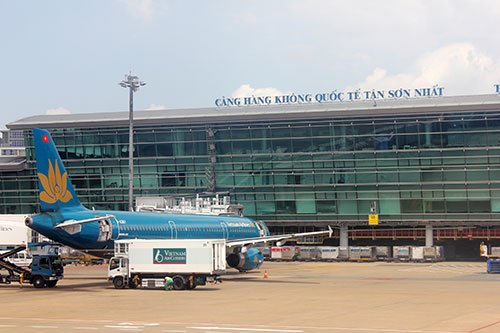
Upon our arrival, our Airbus A321 parks at a remote stand, thus requiring airport buses to get us to the terminal. Along with past experiences, it seems that when Vietnam Airlines (VNA) uses A321s for regional services, those flights are highly likely to be assigned to these remote gates, probably saving the jetbridges for widebodies.

Read more: Vietnam Airlines' Boeing 787: New Lie-Flat Seats in Business, 2 Different Economy Configurations

Image source: Vietnam Investment Review
One (very tiny) upside to the remote stand is that they deplane and board through both the front and back at the same time, so those stuck in the rear of the plane aren't waiting forever to get off.

Those in business class are provided their own shuttle bus, which departs quickly. The economy passengers are directed to 3 other larger buses, each one taking off once full.
Pro Tip: Stand near the left-side doors to be the first to get off at the terminal.
After a 5-7 minute ride to the terminal, we are deposited at the entry doors which lead to a narrow escalator that took us up to the arrivals level. We follow the signs to the arrivals hall, just a short walk away.

The arrivals hall at SGN is divided up into three sections:
  • The main immigration inspection section, where passports are checked before entry.
  • A visa window, for those who pre-arranged to receive a "visa on arrival."
  • A transfer desk, for those who are making onward international connections.
Today was a little busy, with at least 3/4 of the immigration booths manned, and each having lines of 15-20 passengers each. The visa window had about 20 people waiting in line, with another 30 waiting for their applications to be processed.

Our line has a passenger that they examined more closely than normal, so it takes us about 30 minutes to finally get through (should have been about 15 minutes). We head down to claim our baggage, which is already sitting off the belt, as our flight's bags have completed offloading. We load our bags onto free carts provided by the airport, and my wife goes for a restroom break.

While I'm waiting, I scan the customs inspection lines that we have to go through before exiting. A customs "officer" tries to wave me over, but I give the "not ready" hand signal and continue waiting.
Pro tip: Never go towards a customs line that you've been directed to, since frankly you don't have to follow their direction. The sad reality is that forced bribery is alive and well at SGN and other airports, and the agent is essentially fishing, trying to get me to come over so I can be "carefully inspected" and assessed some sort of trumped up violation, in hopes that I will "pay the fine" on the spot.
What one should do is to choose a line that looks like someone is already "being spoken to" since they already busy with that person and will let you pass.
When my wife returns, I guide our carts to a line far away from that agent. We successfully have our baggage x-rayed with no challenge, and we were quickly on our way out to the curb.

As we pass by, I overhear a poor American fellow in his mid-50s who was trying to reason with the customs agent, who in turn threatened to detain his baggage for 3-4 days. Shameful... I wanted to help him too, but I also didn't want to stick around and be inspected myself (though I probably would have if I was by myself).

We make our way through the throngs of people waiting for their loved ones, make a left turn and head towards the taxi "stand" near the end of the terminal building, past the Popeye's Fried Chicken stand (great place for a quick and cheap snack or drink).

The stand is really more of a collection area where taxis pick up customers, and no real defined queue, even with the permanent corral set up.
Pro tip: Walk past the taxi corral and the crowds, farther along the curb. Flag down the taxi of your choice when it approaches. The driver doesn't really care who they pick up. This is how the system at SGN works. 
If you're uncomfortable with this, you'll probably be waiting a while, but you can get a dispatcher to help you. Each taxi company has its own dispatcher in uniform in the taxi area.
I prefer Vinasun... it has the most number of taxis in the company, are the most reliable, and always use the meter. MaiLinh is a decent Plan B. I pretty much avoid all other taxi companies.
Taxi pickup area at SGN.
We quickly get into a Vinasun taxi van and we're on our way into the city.

Stay tuned for the rest of my trip report, before our Shanghai-Saigon flight and on our way home. Thanks for reading!
- VNAFlyer


Sunday, January 25, 2015

8 Simple Tips for Preventing Theft on Your Next Flight

VNA discloses recent rise of in-flight theft. VNAFlyer has tips for making it more difficult for would-be looters on any flight to steal your valuables.


With 32 reported cases of theft while in-flight (and likely more that go unreported), Vietnam Airlines (VNA) has started warning passengers to be more wary during their flights.

A passenger on a January 19, 2014 VNA
flight caught in the act of stealing from
others. Image source: Trung Hieu/
Thanh Nien News
Onboard theft has always existed, but VNA has seen an unusually high number of incidents recently. Apparently, thieves from China and Hong Kong are methodically targeting passengers, especially those traveling in business class, and selecting their targets as soon as at the check-in counters to steal from when onboard.

The linked article above doesn't provide details on what one should actually do, so VNAFlyer is here to fill in the gaps. While it may be impossible to stop a very determined thief, you can make sure to make it more difficult for them.

Applicable for any flights in general (not just VNA), here are my 8 simple tips for making it that much harder for these criminals to rummage through your belongings:
  • Don't put large amounts of cash or other valuables in your bag, then be separated from it. This seems like an obvious one to me, but a recent incident onboard VNA involved a Japanese passenger who almost lost the equivalent of US$49,500 to thieves. Keep this money on your person, or at least don't get separated from your bag by putting it overhead.
  • Don't use a travel lock. These just draw more uninvited attention to the fact that you may have something valuable, and a thief with a ballpoint pen wouldn't be deterred anyway:
  • Board early, so you have plenty of room to select where your bag goes. Hint: Someplace with a good line-of-sight.
    • Place your bags ahead of you, so you can have an eye on anything that happens near your bag.
    • Place your bags across the aisle from you, for the same reason as above. For inexplicable reason, humans have a need to put their bags right above their heads. Nothing, except for society peer pressure, requires you to do that, nor prevents you from putting your bag somewhere else. The overhead space is first-come, first-served, so just pick a spot.
  • When stowing your bag overhead, place your zippers inside and down to make it more difficult to access. On a standard carryon suitcase, this means positioning your zippers at the top (while it's standing), then putting your bag in top-handle first/wheels out, as well as front down/pull-handle up.
  • Sit in the aisle seat. If something should happen, you can more easily "inquire" about the suspicious activity, if you feel that it's safe to do so. It would be difficult to do the same thing from the window seat.
  • Don't be afraid to ring the call button if you think something suspicious is going on.
  • Don't sleep. Obviously not possible in some cases, but if you can stay awake, you can keep an eye on things.
  • Don't leave valuables out on the tray table, in your seat back pocket, or on your seat while you sleep or leave your seat. Why is it people all of the sudden trust perfect strangers when they board a plane? Most people wouldn't even think of leaving their cell phones, purses/wallets, passports, tablets, cameras, or laptop on a table at a restaurant, yet have no problem leaving these same things unattended while going to the lavatory. Consider the plane to be a public space.

Do you already do any of these things yourself? Do you have your own tips you'd like to share? Comment below!