Search This Blog

Friday, February 13, 2015

Korean Air Plane Clips Another in While Taxiing in Yangon, Takes Off Before Returning

A Korean Air Airbus A330-200, the same
aircraft type that was involved in the
collision incident in Yangon.
A Korean Air Lines (KE) plane clipped a Bangkok Airways (PG) aircraft while taxiing away from its gate for a Thursday night departure from Yangon, Myanmar (RGN) to Seoul, South Korea (ICN). 

There were no injuries reported among the 134 passengers and 11 crew on board.

The wingtip of the KE Airbus A330 made contact with the parked PG plane as it passed by. The pilots were not aware of the contact due to darkness, and no alarms were triggered in the flight deck. With no fault indications, the flight crew continued their departure rollout and took off.

However, ground personnel did see the collision and reported the occurrence to the control tower. The pilots were advised of the situation after about approximately 20 minutes in the air and they chose to return to Yangon.

Passengers were rebooked onto a flight the next afternoon.

Passenger Fined US$187 for Smoking on a VNA Flight; Is That Enough?

An Australian-Vietnamese passenger was fined 4 million (US$187) for smoking in a lavatory on board a Vietnam Airlines (VNA) flight inbound from Australia.

The incident happened Wednesday on flight VN772 from Sydney (SYD) to Tan Son Nhat Airport (SGN).

The flight crew was alerted when the smoke detector in the lavatory was triggered. Flight attendants then found the passenger, Ta Ngoc Tuan, in the lavatory with an open pack of cigarettes and smoking.

The maximum fine that can be imposed in Vietnam is ₫5 million (US$237).

Vietnam is trying to earn the Federal Aviation Administration's (FAA's) approval to start direct flights to the U.S., but the aviation safety standards in Vietnam have so far not passed muster.

This low fine is one of the symptoms of the lax civil aviation system in Vietnam. Even the Southern Airports Authority (SAA), which levied the penalty, admitted that the fines were not high enough to deter smoking on board, and this latest incident was the second documented case this year.

I do find it curious that after stating that fact, the SAA still did not levy the maximum penalty.

Read more: Boeing Signs Memo with CAAV, Pledges to Help Start Direct Vietnam-US Flights

But beyond that point, while a possible US$237 fine may be steep to some, it pales in comparison to other countries' penalties. Punishment for the same violation in the United States can be up to US$5,000 (₫106,650,000), along with immediate arrest and possible prison time.

Image source: Wikipedia
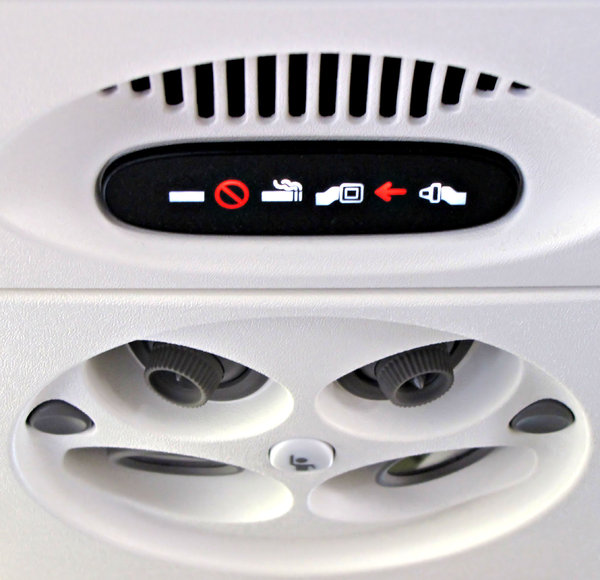
Why is this such a big issue for the airlines and aviation authorities? Most would point to the incident involving Varig Flight 820, where the cause of a fire was suspected to be a cigarette butt that was discarded in the lavatory waste bin and ignited the contents. The fire subsequently lead to a crash landing in a field, where the aircraft was consumed by flames.

Of the total 134 persons on board, only 11 survived. Many of the 123 deaths occurred before the crash due to smoke inhalation.

The civil aviation authorities in Vietnam should have the means to deter seemingly minor violations such as smoking in the lavatory, and a maximum find of a couple of hundred dollars just isn't going to cut it.

Combine that with the cultural phenomenon in Vietnam and elsewhere in Asia of people sneaking into public restrooms to skirt no-smoking policies for a quick smoke. This behavior may be a mere nuisance on the ground in a coffee shop, but can have catastrophic effects while in-flight. The fines must be steep enough to alter behavior that many consider to be "normal."

I'm glad this passenger was punished, but am disappointed that the SAA did not levy the maximum fine allowed, and very concerned that the fines overall are so little.

I would bet the FAA shares the same concerns.

Do you think the fine was high enough? Too much? Just right? Leave a comment below!

Thursday, February 12, 2015

Trip Report: Getting Shanghaied from Seattle

Intro: Ticketing and Getting Ready

This is the first chapter of this trip report; however I did start writing this report starting in the middle, when I met up with my VNA flight

Other chapters:
Being based in the US, I do have to fly other airlines to get to Vietnam (or to connect to a Vietnam Airlines [VNA] flight) since VNA can't fly directly to the US. My preferred carrier is American Airlines (AA), and on this trip my lovely wife and I were starting our trip in Seattle (SEA).

Our itinerary:
  • Outbound
    • Day 1: Fly from SEA-Los Angeles (LAX) on Alaska Airlines (AS); spend the night in Los Angeles (14 hours)
    • Day 2: Fly from LAX to Shanghai (PVG) on AA; spend the night in Shanghai (20 hours)
    • Day 3: Fly from PVG to Saigon (SGN) on VNA, reaching our final destination.
  • Return
    • Day 1: Fly from SGN to Tokyo-Narita (NRT) on Japan Airlines (JL); 1.5 hours connection in NRT, then flying NRT-LAX on AA; spend the night in Los Angeles (23 hours)
    • Day 2: Fly LAX-SEA, completing our trip.
Image source: Seattle/Tacoma
International Airport / Facebook
Even though our first flight was with AS, it was still an AA-issued ticket and it was the controlling carrier by virtue of the international segment operated by AA.

We were able to take advantage of some long layovers allowed by our fare rules, so we were able to visit family in LA twice, as well as visit Shanghai.

This trip required me to go out to the airport to book and ticket, not because it was complicated, but because there seemed to be a problem with AA's system communicating with JL's systems and showing the correct availability.

The airport agent was quite surprised that anyone decided to come in personally to book a ticket, but I'm glad I did. It took him several attempts but he finally managed to get the system to book my itinerary (again, it wasn't because of the complexity, it was because JL's system denied that there was the available fare). With printed confirmation in hand, I go home to pack up and leave in a few days' time.


Travel Documents

Thankfully, my U.S. passport still has several years before expiration (entry into Vietnam requires at least 6 months of validity), and I have a visa waiver issued from Vietnam (valid for 5 years), meaning that I'm not required to apply for a visa when I visit. The stress of having the apply for the visa and wait for it to be issue is eliminated, and I can focus on other things.

Image source: US CBP
I've also previously signed up for Global Entry (GE), an expedited reentry program from U.S. Customs and Border Protection (CBP). Part of the "Trusted Traveler" family of programs, GE holders agree to a background check to be declared as low-risk and be given access to lines for both passport and customs inspections upon returning to a U.S. airport, so that the holder does not have to stand in the regular lines.

My first time using GE was at LAX, before the most recent renovations to the Tom Bradley International Terminal. I decided to time myself from the opening of the aircraft door to exiting the building: 18 minutes, the majority of which was waiting for my checked bags to come out. I had essentially skipped every line, and never had to wait behind anyone. I had lunch with a friend last week who took 4 hours to exit LAX, and that's as a US citizen.

Image source: TSA
Also included with Global Entry is TSA Pre-Check, which you may have seen at the airport. Pre-Check allows for expedited security screening (again, on the basis that you're a trusted traveler), and gives access to a special line where you do NOT have to take off your shoes or take out your laptop.

The application fee for Global Entry costs $100, and is non-refundable if you are happened to be denied. After applying online, you'll have to schedule an interview at a Global Entry office (located at most major airports).

A similar program called NEXUS costs just $50 and allows the holder to also enter Canada on an expedited basis. However, the required interview must be scheduled at a border office, and appointments are usually booked months in advance because it requires the presence of a Canadian immigration agent as well.

If you can get to the border, and have plenty of lead time, NEXUS is the best deal, costing half of Global Entry yet including all the benefits.

Next chapter: Checking in at Seattle-Tacoma International Airport (SEA); SEA-LAX on Alaska Airlines

VNAFlyer's Packing Guide for Carryons (and Packing Them)

Logging lots of miles on a plane each year, on both domestic and international flights, I have developed a routine that I follow when it comes to being equipped. I usually try to survive just with what I have in my carry-ons, but on some trips, especially those back to Vietnam that always turn into resupply missions, I'll have to use my checked baggage allowance. Even then, what I bring with me on board doesn't change much.

The Hardware

Generally I like to travel with a laptop backpack and 21" a spinner rollaboard suitcase, which follows most carriers' restrictions of one carry-on suitcase and one personal item.

Ogio Urban, with laptop section
opened out for security screening.
I choose a backpack over a briefcase or shoulder bag because I frees up both of my hands, and balances out the weight in the bag. The key features I like in a backpack:
  • TSA-checkpoint friendly laptop compartment (it flips out on the X-ray belt so you don't have to take out your laptop)
  • Separate padded tablet compartment
  • Quick-access pocket, to put items in during security screening (like wallet and phone)
  • Reinforced and ergonomic top handle, easy to hold and someplace I can loop my security cable through.
  • Pass-through for a rollaboard handle, so my backpack can sit on top of my suitcase
  • Sternum strap, to help distribute heavier loads
  • Bottle holder, to free up hands for other things
For the past few years I traveled around with an older Ogio Urban, which I liked but it was missing the pass-through (so I would just loop my armstraps around the handle) and the sternum strap. It had plenty of pockets all over, so was never left wanting for storage space.

Recently I started looking for a new bag, and out of sheer luck I found my bag's almost-exact clone. The differences were that it had a both a pass-through and a sternum strap! It was also rebranded as a Kenneth Cole Reaction bag, which makes no difference to me (and in fact I would prefer if it didn't have the emblem affixed to my bag).

For my rollaboard, I personally think that it's a waste of money to spend hundreds (much less thousands) of dollars for luggage. The baggage handlers, walls, floors, and overhead bins don't care how nice your luggage is. Neither do, for the most part, your fellow travelers.

Samsonite LIFT
My preferred features for a rollaboard:
  • 4-wheel spinner
  • Shallow accessory pocket, for storing small items at security screening
  • Rigid handle
  • Lightweight, under 7 lbs/3.2 kgs
  • Grab handle at the bottom
  • Curb guard
Right now I have a Samsonite LIFT lightweight spinner. Now, I know Samsonite's quality has been questionable in recent years, and honestly I would never pay US$200-300 in full retail price for one. 

However, if you go to one of those reseller stores, like Ross Dress-for-Less, Marshalls, or TJ Maxx, you can always find Samsonite (and other) sets for cheap. At US$65-80 per rollaboard, these are almost disposable... or at least you won't feel terrible after it gets it's first scuff.

Additionally, Samsonite and American Tourister are owned by the same company. I happened to walk through my local Target store today and found my carry-on rebranded as an American Tourister, and being sold brand new for US$69 on sale.

As long as the suitcase lasts at least 5 years, you're already ahead. And new or not, I prefer changing my suitcases that often anyway to get the latest features and design.

It's important to note that while 22-inch suitcases are allowed to be carried on on U.S. airlines, they are slightly too large be allowed on most of the other world's airlines, which is why I opt for the 21-inch.

The Goods

As for the actual items I pack, I have a mental list of basic essential items to have onboard with me, so some items on this list may not be for everyone.
  • Wearables
    • An extra change of clothes - never know when you'll get stranded at a connecting airport, or need a change during a flight
    • Extra socks (to walk around in, but NEVER wear them into the lav!)
    • Eyeshades
    • Earplugs
  • Personal care
    • Toothbrush/toothpaste - it's the one thing a non-status economy passenger can do to feel human again after a flight
    • Floss
    • Sanitizing wipes - lavs are gross... and have you never wiped down your seat and tray table?
    • Personal wipes - lavs are still gross
    • Hand sanitizer - planes in general are gross
    • Lotion or moisturizer
    • Contact lens case/solution/drops
    • Glasses - the air on the plane will dry out your contacts
  • Electronics
    • Laptop/tablet
    • Noise-cancelling headphones (remember your adapters!)
    • Battery pack - in case you need to recharge your phone or tablet, and there's no outlet
  • Accessories
    • Laptop security cable
    • Pen
    • Sunglasses
    • Collapsible water bottle
    • Flashlight - a small compact one, because you never know when you'll drop something!

One last tip: DON'T overpack. Being weighed down by bringing things you won't even touch onboard or use on your trip will just make your travels that much more difficult. Dead weight is no fun... get rid of it!

Would you add anything to this list? Share in a comment below!

Wednesday, February 11, 2015

American Confirms 1st 787 International Routes to Beijing, Buenos Aires

American Airlines (AA), which took delivery of its first Boeing 787-8 Dreamliner (B788) last month, officially announced today the first revenue flights for the new advanced widebody aircraft.

AA's B788 will be based at Dallas-Fort Worth (DFW), AA's headquarters and main hub. On May 7, it will initial fly domestic familiarization and training flights to Chicago-O'Hare (ORD) twice daily.

On June 2, the B788 will make its inaugural international flight from DFW to Beijing, China (PEK). After its return from PEK, on June 4 it will then fly to Buenos Aires, Argentina (EZE).

These flights will be available for booking starting this Saturday, February 14.

"We look forward to welcoming our international customers onboard the 787 with its modern amenities and comforts beginning this summer," said Andrew Nocella, American's chief marketing officer. "Adding the 787 Dreamliner to our network gives us the opportunity to increase our efficiency on long-haul flights across the globe and potentially open up new markets in our network. It's a big win for customers and just the latest example of how American is going for great."

For travelers from the United States to Vietnam, AA's DFW-PEK flight opens up another option, as AA fare rules generally allow passengers to connect in China onto Vietnam Airlines (VNA) and other carriers. For instance, a passenger can fly DFW-PEK then onward to Saigon (SGN) or Hanoi (HAN) on VNA.

VNA is set to take delivery of its own Dreamliner later this year.

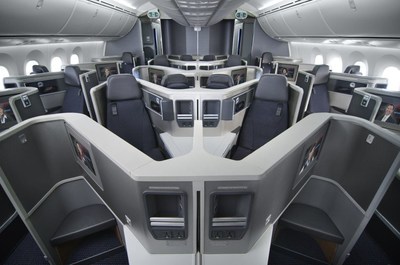
The B788 will have 2 classes of service, with 28 lie-flat seats in business class with all-aisle access, arranged in a unique 1-2-1, foreward/backward-facing configuration. In-flight entertainment is on a 15.3-inch HD touchscreen, and Bose noise canceling headsets will be provided. A walk-up bar for midflight drinks and snacks will also be available.

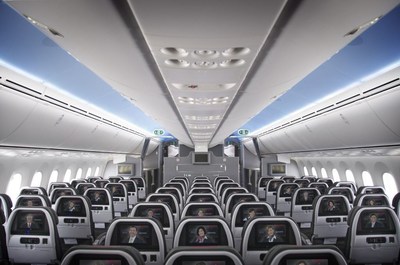
In economy, there are 198 seats in a 3-3-3 configuration, 48 of which will be in the extra-legroom Main Cabin Extra section, reserved for the airline's elite passengers and also available for a fee. Each economy seat will feature a 9-inch HD touchscreen.

All seats will feature universal AC and USB power outlets, as well as onboard Wi-Fi.

AA has ordered 42 Boeing 787s in total, in both the -8 and the stretched -9 versions, with options for 58 more.

Tuesday, February 10, 2015

Vietnam Airlines Releases Interior Images for 787, A350

On Tuesday, Vietnam Airlines (VNA) posted seatmaps and rendered images for their new Boeing 787-9 (B789) and Airbus A350-900 (A359) aircraft. The images appeared on VNA's official Facebook page.

The images confirm my previous anonymously-sourced information on the B789 that the new business class seats are the Cirrus from Zodiac Aerospace, the deluxe economy seats are from HAECO (nee TIMCO), and the economy seats are the lightweight Pinnacle seats from B/E Aerospace.
Rendering of VNA's B789 business cabin.
Image source: Vietnam Airlines

Rendering of VNA's B789 deluxe economy cabin.
Image source: Vietnam Airlines

Rendering of VNA's B789 economy cabin.
Image source: Vietnam Airlines
What was surprising to me were the images for the A359 interior. Instead of going for fleet commonality in business class by installing Cirrus on the Airbus, VNA opted to use what looks like a version of EADS Solstys, which is a staggered forward-facing product.
Rendering of VNA's A359 business cabin.
Image source: Vietnam Airlines
Also surprising: It seems that VNA is choosing outfit the A359's deluxe economy cabin with the regular Pinnacle economy seats, still at 9-abreast in a 3-3-3 configuration (instead of the 7-abreast, 2-3-2 truly bigger seat configuration on the B789), just with more legroom!
Rendering of VNA's A359 deluxe economy cabin (?).
Image source: Vietnam Airlines

Rendering of VNA's A359 economy cabin.
Image source: Vietnam Airlines
I'm really REALLY hoping that the A359's configuration is not set in stone, especially in regards to the deluxe economy cabin. While VNA apparently installed a proper premium economy product on the B789s, they didn't do anything special on the A359s except give more leg room (akin to what many US-based carriers do). Perhaps this was a mistake in posting the images? Or an incorrect interpretation?

I feel that VNA had the chance to ensure fleet commonality in seating and features, departing from their previous ragtag fleets mixed from owned aircraft and aircraft from different lessors. Instead, they provide two completely different premium cabin products, which can only lead to operational complexities, crew confusion and dissatisfaction for the premium passenger.

I'll admit that I love the Cirrus seat, and I'm sure that the Vantage XL is a fine product as well. I do feel they should have stuck with one or the other. My speculative guess? There may have been a seating supply shortage from one vendor that required using the other's product, as to not delay delivery for either aircraft any longer.

One last small point of contention: I do hope VNA follows the lead of other carriers of installing a proper walk-up bar in business class, instead of what was pictured:
Image source: Vietnam Airlines
Still, it's an exciting time for VNA, with two new widebody types coming online this year to replace their aging long-haul fleet. New planes, new cabins, new seats, and even Wi-Fi on board.

What about that seat map?
Let's compare what I thought the seatmap was going to be vs. what was actually released by VNA.
VNAFlyer's predicted mockup.
VNA's released seatmap.
I think I came pretty close! Especially with the deluxe economy seats and the economy section after the 3rd doors. What I didn't get quite right:
  • While I knew there were 211 seats in economy (and VNA's seat map confirms this), I miscounted and only put 205 seats;
  • I might have given deluxe economy a little too much leg room;
  • I was off on some of the mid-cabin lavatory and galley positions;
  • My business class rows were off, with the middle set more forward rather than being in line with the window seats.
Hopefully VNA will release a seatmap of the A359 soon, so that we can confirm my worst fears the seating arrangement.


(H/T: Flyertalk user nam_sg)

Monday, February 9, 2015

Vietnam Airlines' Inaugural 787-9 Flight to London-Heathrow on June 29

The inaugural international service for Vietnam Airlines' (VNA's) new Boeing 787-9 Dreamliner (B789) is currently scheduled to be on June 29, 2015, flying from Hanoi (HAN) to London's Heathrow Airport (LHR).

This replaces service currently flown on VNA's Boeing 777-200ER (B772).

Flight VN055 will depart HAN at 12:30am for an overnight flight, arriving at LHR at 6:40am.

Read more: Vietnam Airlines' Boeing 787: New Lie-Flat Seats in Business, 2 Different Economy Configurations

The first return flight, VN054, will depart from LHR at 2:45pm on June 29, and arrive back at HAN the next day at 7:50am.

Then on June 30, the B789 will operate a revenue domestic flight for repositioning, Flight VN237 from HAN to Saigon (SGN), departing at 10:00am and landing at 12:05pm.

The first B789 flight out of SGN will depart early on July 1 at 12:05am and arrive at LHR at 6:40am the same day.

Read more: Vietnam Airlines: In-Flight Wi-Fi to be Available on New 787, A350 Aircraft

It seems that while the equipment information has been loaded, VNA is using their B772 seatmaps as placeholders, so if while one can select a seat on a flight scheduled to be on a B789, it's very likely to change.
A screenshot of the seatmap that appears on the LHR routes operated by the B789,
though it's clearly the configuration for the B772. Image source: Reader Andrew R.

A blog reader reports that he was able to select a business class seat on the map, even though he is currently booked in a premium economy seat. I cautioned him to:

(H/T: Andrew R.)